
This article continues the BI Body Intelligence methylation series, published in collaboration with ACPN — The Association of Certified Professional Nutritionists (professional review: Thomas Lin 林存默).
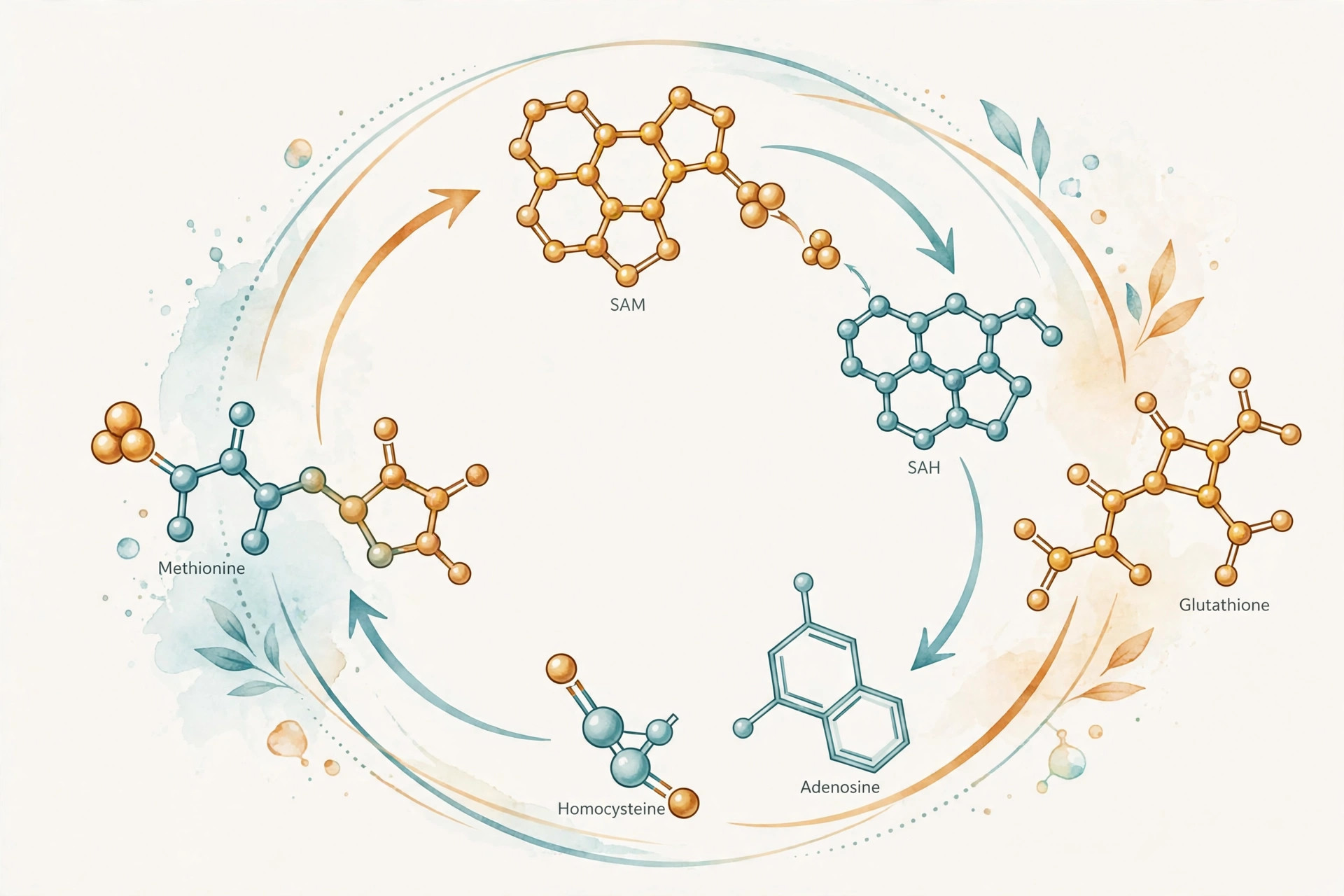
Earlier we discussed SAM — one of the body’s most important methyl donors. After SAM hands a methyl group (–CH3) to another molecule, it does not turn directly into homocysteine. Instead, it first becomes:
SAM → SAH
SAH’s full name is S-adenosylhomocysteine.
This intermediate deserves close attention, because it is far more than just a precursor to Hcy (homocysteine): SAH itself can inhibit many methyltransferases. In other words, when SAM keeps donating methyl groups but the resulting SAH is not cleared promptly, accumulating SAH can act as a “brake” on methylation reactions.
So the cell must keep processing SAH:
SAH ⇌ Homocysteine + Adenosine
This reaction is catalyzed by SAH hydrolase (SAHH).
Here is a fascinating detail: this reaction is reversible. Under biochemical conditions, it does not inherently “prefer” to run toward Hcy formation. One important reason the cell can drive it forward is that the downstream products are continuously removed.
Adenosine is metabolized further — and homocysteine must also be dealt with. Hcy has two major fates:
- Hcy → Methionine — remethylation back into the methionine cycle (this route needs folate, vitamin B12, and related nutrients);
- Hcy → Cystathionine → Cysteine → GSH — the transsulfuration pathway, which generates cysteine and ultimately glutathione (this route needs vitamin B6).
And now a beautiful metabolic logic emerges:
SAM donates methyl → SAH is formed → SAH must be cleared → Hcy is formed → Hcy must also be cleared.
So an elevated Hcy should not be understood simply as “the body produced too much of something bad.” It is sometimes better read as a signal: there may be an imbalance between the throughput of the entire methylation cycle and the downstream clearance capacity.
That is also why, beyond Hcy itself, researchers of methylation metabolism pay attention to SAM, SAH, and the relationship between SAM and SAH.
Tracing the path from SAM all the way to Hcy, what we see is no longer an isolated lab marker, but a continuously flowing metabolic chain.
Science & Education: BI Body Intelligence (身体智慧)
AI-assisted Research & Illustration: BI × GPT
Professional Review: Thomas Lin (林存默)
Professional Community: ACPN — The Association of Certified Professional Nutritionists
This article is for science education only and does not constitute medical or nutrition advice.